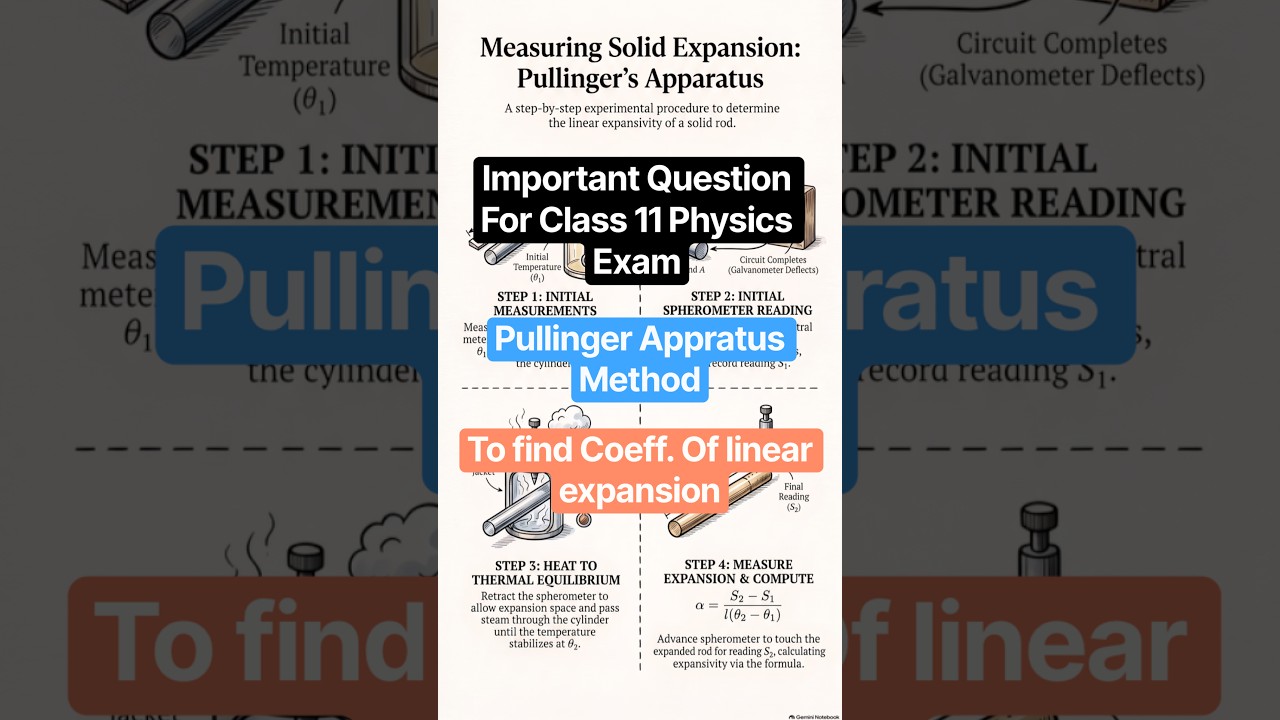
Mastering Physics: How to Measure Linear Expansivity with Pullinger’s Apparatus
This article provides an in-depth exploration of Apparatus, covering foundational concepts, practical applications, and engineering insights.
Have you ever wondered how engineers prevent metal bridges or railway tracks from buckling on hot summer days? In physics, this phenomenon is known as thermal expansion, and calculating it accurately is a fundamental skill for understanding material science. One of the most effective ways to demonstrate this in a laboratory setting is by determining the coefficient of linear expansivity.
In this guide, we will break down how to calculate linear expansivity step-by-step using a classic physics experiment.
Understanding the Setup
To measure how much a solid metal rod expands when heated, precise measurement tools are required because the physical expansion is often microscopic. Pullinger's apparatus is a traditional piece of laboratory equipment designed specifically to measure the thermal expansion of solid materials like brass, copper, or iron rods.
The experimental setup typically consists of a hollow steam jacket surrounding the metal rod, a thermometer to track temperature increases, a steam generator, and a spherometer or micrometer screw gauge to detect tiny changes in length.
Step-by-Step Procedure to Find Linear Expansivity
Determining the coefficient of linear expansivity ($\alpha$) of a metal sample requires a clear, controlled methodology:
- Measure Initial Values: Begin by measuring the initial length ($L_1$) of the cold metal rod at room temperature ($T_1$) using a meter rule.
- Set Up the Equipment: Mount the rod inside the steam jacket of the apparatus, ensuring one end is fixed while the free end touches the measuring gauge to establish a baseline reading.
- Pass Steam: Connect the steam generator to pass steam through the jacket, uniformly heating the metal rod until the temperature reaches a steady maximum state ($T_2$).
- Record Expansion: Carefully turn the micrometer screw gauge to touch the expanded rod and record the small change in length ($\Delta L$).
- Apply the Formula: Calculate the linear expansivity using the formula:
$$\alpha = \frac{\Delta L}{L_1 \times (T_2 - T_1)}$$
Key Tips for Experimental Accuracy
Because thermal expansion in solids occurs on such a small scale, minor errors can distort your results. Ensuring that your apparatus is well-insulated, taking careful zero-readings on your micrometer, and allowing the temperature to stabilize are crucial steps for getting precise calculations.
By understanding this fundamental experiment, you can easily tackle practical lab assessments and master the core principles of thermal physics!


