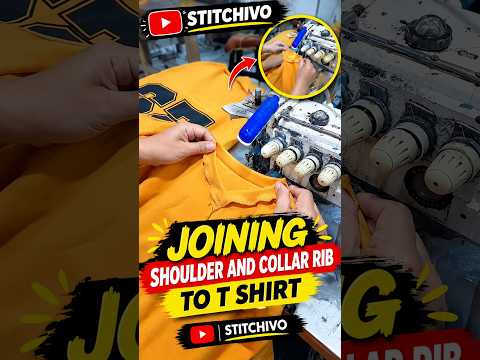
Creating a durable, well-fitted T-shirt requires precision, sound technique, and the right equipment. Whether you are running a commercial garment factory or refining your textile craftsmanship, mastering shoulder seam attachment and collar ribbing is crucial for achieving a clean, professional finish. By utilizing specialized industrial tools and proven sewing practices, you can dramatically elevate the structural quality and aesthetic appeal of your apparel.
Step 1: Joining the Shoulder Seams with Precision
The shoulder seam acts as the primary anchor of any T-shirt. To ensure it withstands daily wear and movement without stretching out of shape, it must be stitched securely and evenly.
Start by aligning the front and back shoulder panels with the right sides facing together. Feed the fabric smoothly through a high-speed overlock sewing machine. Utilizing reliable industrial tools designed for textile manufacturing ensures that the differential feed prevents fabric warping while creating a neat, durable edge lock. For added durability, professional apparel makers often insert clear elastic tape or shoulder tape into the seam during this step to maintain structural integrity over time.
Step 2: Preparing and Attaching the Collar Rib
Attaching a collar rib is often considered the trickiest stage of basic garment construction, but a systematic approach makes it effortless.
- Prep and Mark: Fold the collar ribbing lengthwise with wrong sides together, pressing it flat. Quarter-mark both the ribbing and the neck opening into four equal sections to guarantee even tension across the curve.
- Align and Stitch: Align the quarter marks of the ribbing to the neckline.
- Control Tension: As you stitch along the neckband, gently stretch only the rib fabric—never the T-shirt body fabric—to fit the curve perfectly.
Maintaining uniform stretch during this phase prevents puckering and yields a flat, crisp neckband that resists bowing even after multiple washes.
Elevating Garment Quality Through Machinery
While manual sewing methods work for simple crafts, consistent garment production relies heavily on dedicated workshop machinery. Modern industrial tools—such as specialized overlock machines, coverstitch units, and automated rib-feeders—allow creators to achieve consistent stitch density, proper thread tension, and peak efficiency.
By pairing these step-by-step assembly techniques with robust commercial equipment, attaching T-shirt collars and shoulder seams becomes a smooth, repeatable process. Master these fundamentals today to take your garment production to a higher standard!


