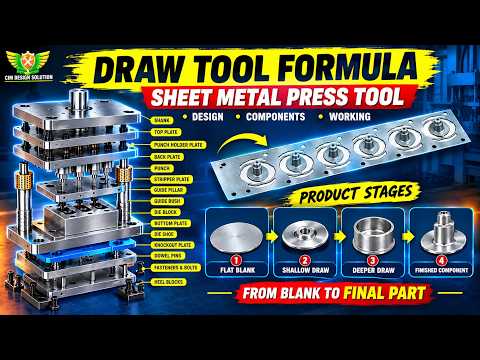
In the modern manufacturing landscape, sheet metal forming plays a crucial role in producing complex components across various sectors. At the heart of this process lies press tool engineering—specifically draw die design. Achieving perfection in draw die design requires a blend of deep engineering knowledge, precise mathematical calculations, and high-performance industrial tools.
Understanding Draw Die Design in Sheet Metal Manufacturing
Draw die design is a specialized branch of tool engineering used to transform flat sheet metal blanks into three-dimensional hollow shapes without tearing, thinning, or excessive wrinkling. The process involves placing a metal sheet over a die cavity and drawing it into shape using a punch.
To ensure flawless production runs, engineers must carefully evaluate parameters such as blank holder pressure, die entry radius, punch radius, and drawing clearances. Utilizing accurately engineered industrial tools ensures that the sheet material flows smoothly into the die cavity, reducing internal stress and preventing surface defects during deep drawing operations.
Key Calculations for Precise Draw Die Engineering
Designing an efficient draw die relies heavily on accurate calculations. A single error in calculation can lead to material failure, premature tool wear, or incorrect final dimensions. Fundamental calculations include:
- Blank Size Determination: Calculating the exact flat blank diameter required to form the finished component while minimizing material waste.
- Drawing Force & Blank Holder Force: Estimating the press capacity needed to deform the metal while maintaining sufficient flange pressure to prevent wrinkling.
- Percentage Reduction: Determining whether a component can be drawn in a single stage or requires multiple re-drawing operations.
Integrating Computer-Integrated Manufacturing (CIM) design principles alongside modern software allows toolmakers to simulate material flow and refine these calculations before physical production begins.
Maximizing Efficiency with Quality Tooling
The longevity and reliability of sheet metal forming operations depend heavily on the quality of your tooling setup. Proper material selection, heat treatment, and surface coating are critical when fabricating robust industrial tools built to withstand continuous high-tonnage press cycles. By combining precise draw die calculations with advanced tool design techniques, manufacturers can achieve consistent product quality, minimize scrap rates, and optimize overall operational efficiency.


