Inside the Modern Electronics Factory Plant: How Resistors Are Made
This article provides an in-depth exploration of Factory plant, covering foundational concepts, practical applications, and engineering insights.
Every modern electronic device—from your smartphone to your electric vehicle—relies on tiny components to safely control electrical current. Among these, the humble resistor is perhaps the most fundamental building block in circuit design. But have you ever wondered how a component smaller than a grain of rice is mass-produced with absolute precision?
To find out, we must step inside a modern electronics factory plant to witness the fascinating step-by-step process of carbon film resistor manufacturing.
Step 1: Ceramic Core Preparation and Carbon Coating
The journey of a carbon film resistor begins with a tiny, solid cylinder made of high-grade ceramic material. Ceramic is chosen because it serves as an exceptional electrical insulator capable of handling high temperatures without degrading.
Inside the factory plant, these ceramic rods undergo a high-tech process called chemical vapor deposition. A thin, uniform layer of carbon film is deposited over the ceramic core. The thickness of this microscopic carbon layer establishes the initial electrical resistance baseline.
Step 2: Helical Laser Grooving for Precision Tuning
Once coated, durable metal end caps attached to copper lead wires are pressed firmly onto both ends of the cylinder. However, achieving an exact electrical resistance value requires meticulous fine-tuning.
Automated precision lasers cut a continuous spiral (helical) groove through the carbon coating. By carefully controlling the depth, pitch, and length of this spiral path, the machinery lengthens the track electrical current must travel, allowing the system to calibrate the exact resistance value (measured in ohms) with extreme accuracy.
Step 3: Coating, Color Banding, and Quality Control
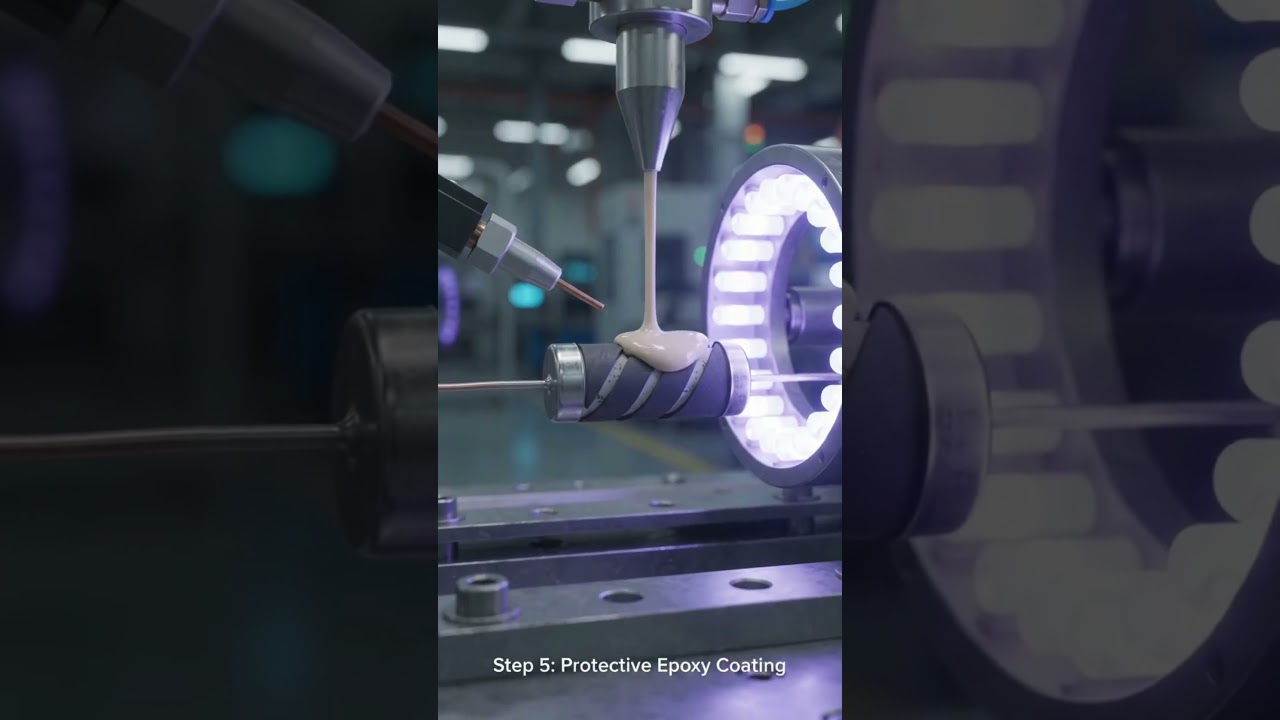
To protect the delicate carbon path from environmental damage, moisture, and oxidation, the resistors are encapsulated in multiple protective layers of insulating epoxy resin or lacquer.
Next, high-speed marking machines paint iconic color bands onto the outer body of the resistor. These standard color codes allow engineers and technicians to identify the resistance value and tolerance level at a glance. Finally, before leaving the high-tech factory plant, every batch undergoes rigorous automated electrical testing to guarantee peak performance and reliability.
Conclusion
The next time you power up your favorite gadget, take a moment to appreciate the hidden engineering marvels inside. Behind every tiny component is a highly efficient manufacturing facility turning raw ceramic and carbon into the essential building blocks of modern technology.


