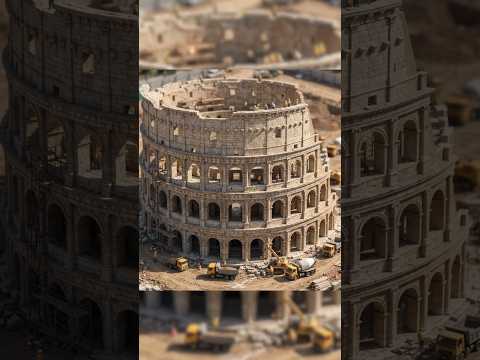
The Roman Colosseum remains one of the most iconic architectural achievements in human history. Built nearly 2,000 years ago, this massive amphitheater was constructed using a combination of travertine limestone, volcanic rock, and early forms of concrete. While the Romans were master engineers, one cannot help but wonder: how would the construction process change if they had access to the high-tech machinery of the 21st century?
A Feat of Ancient Engineering
In the first century AD, the Flavian Dynasty utilized tens of thousands of workers to complete the Colosseum in just under a decade. This was an incredible pace for the time, considering every stone had to be quarried, transported, and lifted into place using primitive pulleys and sheer manual labor. The precision they achieved without modern computers or hydraulic systems is nothing short of miraculous.
The Power of Modern Construction
If we were to recreate this masterpiece today, the introduction of modern heavy machinery would revolutionize the timeline. Instead of thousands of laborers carrying heavy loads, a fleet of excavators, tower cranes, and automated concrete mixers would dominate the site.
Modern hydraulic systems can lift weights that would have required hundreds of Roman workers to move. Furthermore, GPS-guided grading and 3D modeling would ensure that every arch and tier is perfectly symmetrical to the millimeter. What took the Romans eight to ten years could potentially be completed in less than three using today’s industrial power.
Efficiency Meets History
The fascination with seeing modern heavy machinery recreate ancient ruins lies in the contrast between eras. While we possess the technology to build faster and safer, the original builders possessed a level of resourcefulness that defined an empire. Watching these digital or physical simulations of "modern-day Roman construction" reminds us of how far we have come—and how impressive the original architects truly were.
Whether it is through the lens of a viral video or a structural engineering study, reimagining the Colosseum with today's technology bridges the gap between our ancient past and our mechanical future. It highlights the evolution of human capability and the tools we use to leave our mark on the world.


