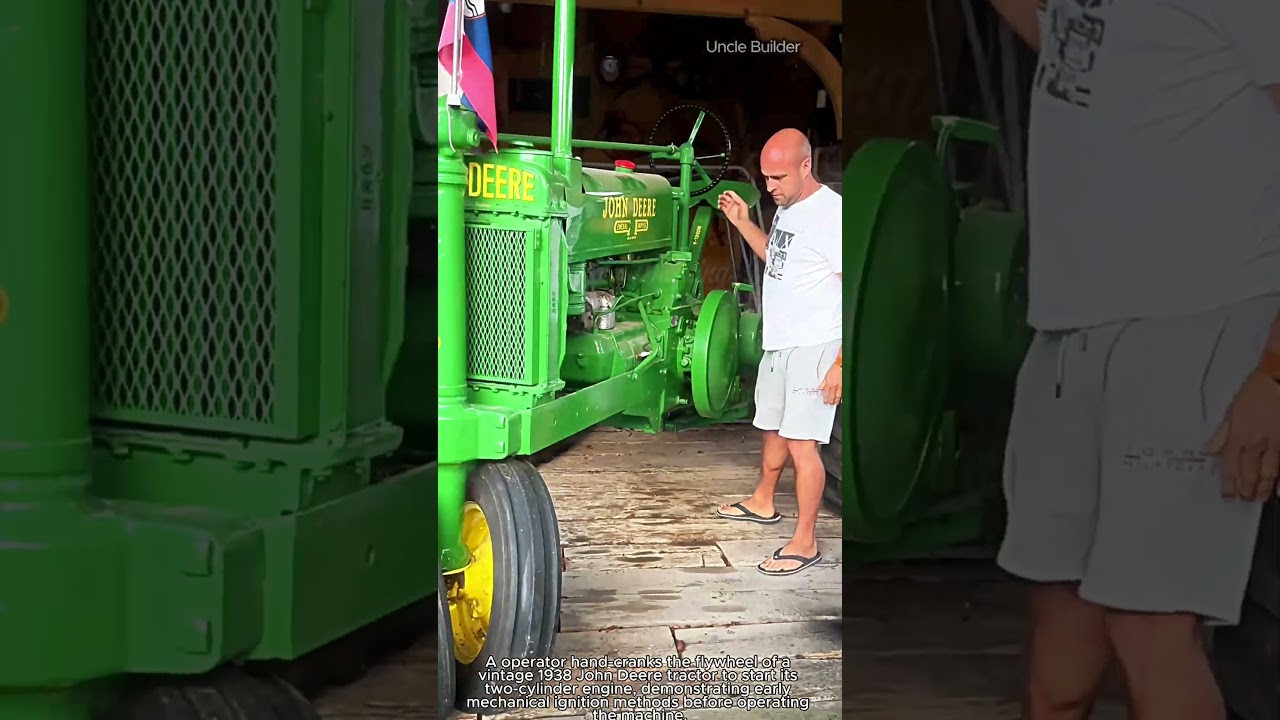
The Lost Art of Starting Vintage Machinery: Hand-Cranking a 1938 John Deere
This article provides an in-depth exploration of Machinery, covering foundational concepts, practical applications, and engineering insights.
Long before push-button ignitions and modern electronic control units existed, operating heavy agricultural equipment required physical grit and deep mechanical knowledge. Among the most iconic relics of this bygone era is the 1938 John Deere two-cylinder tractor—a masterpiece of early industrial engineering that relies entirely on a manual starting process.
Understanding how these classic engines operate offers a fascinating look into the evolution of farm machinery and highlights how far human ingenuity has progressed over the last century.
The Precision Behind the Manual Hand-Crank
Before electric starters became standard across the agricultural industry, operators had to start their engines using physical effort. For a 1938 John Deere tractor, starting the engine was not as simple as grabbing a crank and turning it blindly; it required a precise sequence of mechanical preparations to avoid engine kickback, which could easily injure an operator.
To begin the process, the farmer had to check the fuel valve, prime the cylinders, and retard the spark timing to prevent premature ignition. Once the preparations were complete, the operator engaged the heavy external flywheel, using steady, forceful momentum to rotate the crankshaft against high internal compression.
Engineering Genius of the Two-Cylinder Engine
The famous "Poppin' Johnny" two-cylinder engine design was renowned for its simplicity, fuel efficiency, and distinctive exhaust sound. By utilizing an exposed, heavy flywheel mounted on the side of the tractor, John Deere engineers gave operators a direct mechanical lever to turn the crankshaft.
This smart design feature meant that even powerful, heavy-duty machinery could be brought to life using human power alone. The rotational momentum generated by turning the flywheel by hand pushed the pistons through their compression stroke until the magneto delivered a spark, firing up the engine with a satisfying roar.
Preserving Our Industrial Heritage
Watching a 1938 John Deere engine spring to life through manual hand-cranking is more than just a captivating demonstration—it is a tribute to early mechanical craftsmanship. While today’s advanced machinery relies on computerized systems and effortless electric ignition, witnessing this classic hand-crank process reminds us of the rugged reliability and hands-on effort that built modern agriculture.


