Building a seamless business workflow shouldn't break the bank. However, if you have ever tried building the exact same workflow across Zapier, Make, and n8n, you probably noticed a shocking reality: the final bill can vary wildly.
As modern organizations rely heavily on automation to streamline operations, understanding how these top platforms calculate pricing is essential to managing your software spend. Here is how Zapier, Make, and n8n stack up against each other.
Zapier: Simple Setup, Task-Based Pricing
Zapier remains the undisputed king of user-friendliness and broad app integrations. However, its pricing model revolves strictly around "tasks." Every time Zapier performs an action—like adding a row to a spreadsheet or sending a Slack message—it counts as one task.
If your workflow requires multi-step logic with dozens of internal actions, Zapier can become extremely costly very fast. It is best suited for straightforward, low-volume processes where ease of setup outweighs the per-task price tag.
Make: Visual Workflows and Operations
Make (formerly Integromat) approaches pricing through "operations" or credits. Unlike Zapier, Make provides a highly visual drag-and-drop editor that handles complex, branching logic with ease.
Because Make charges based on individual operations within a scenario, it often proves significantly cheaper than Zapier for intricate data transformations. You get more visual control and flexibility, making it a popular choice for growing teams that need advanced capabilities without enterprise costs.
n8n: Fair Pricing by Executions
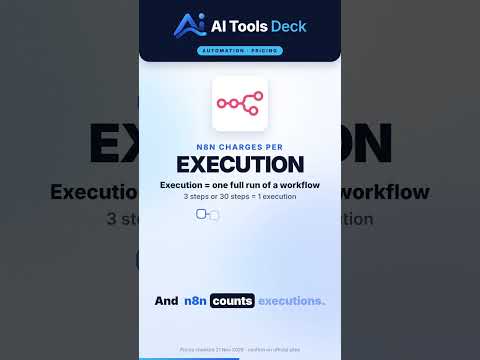
n8n disrupts the market by charging per "execution" rather than per task or operation. An execution represents the entire workflow run from start to finish, regardless of how many steps, nodes, or data points are processed within that single trigger.
For high-volume business automation, n8n offers unmatched cost efficiency—especially if you take advantage of its self-hosted option. A complex workflow processing thousands of data records in one run still only counts as a single execution, saving technical teams substantial monthly expenses.
Which Platform Should You Choose?
Selecting the ideal automation platform comes down to your technical expertise, workflow complexity, and volume. Choose Zapier for quick integrations and simple setup, Make for visual complexity on a mid-tier budget, and n8n for maximum scalability and developer flexibility. By matching your workflow structure to the right billing engine, you can scale your processes efficiently without overpaying.