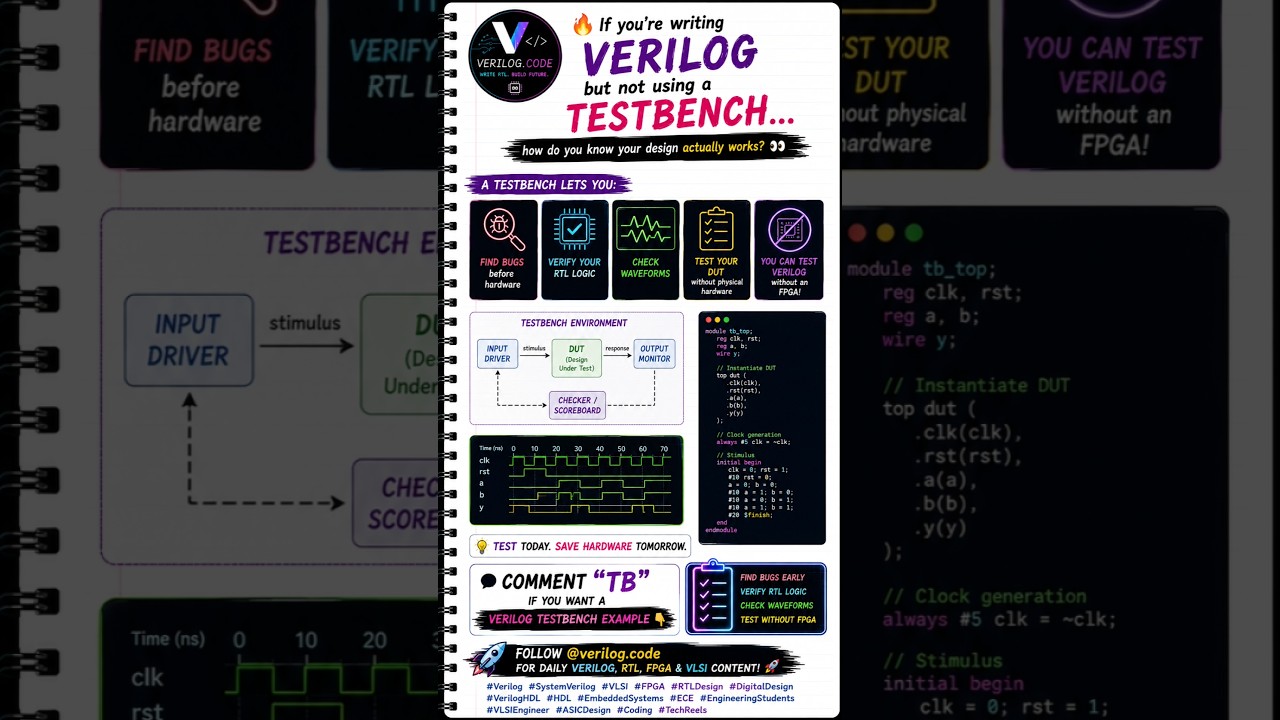
What Is a Verilog Testbench? Verify Your Designs Before Physical Hardware Deployment
This article provides an in-depth exploration of Hardware, covering foundational concepts, practical applications, and engineering insights.
Writing Verilog code for digital design is an exciting process, but writing the code is only half the battle. How can you be absolutely certain that your circuit logic behaves as expected before committing it to physical hardware? That is where a Verilog Testbench comes into play.
What Exactly Is a Verilog Testbench?
A testbench is a simulation environment written in Verilog or SystemVerilog that verifies the functional correctness of a Design Under Test (DUT). Unlike standard synthesizable HDL code that directly maps to physical logic gates, a testbench is non-synthesizable. Its primary job is to generate input signals (stimulus), feed them into your design, and observe the resulting outputs to catch flaws before fabrication.
Why You Must Test Before Deployment
Fixing a bug in your HDL code during simulation takes mere minutes. However, discovering a design flaw after flashing an FPGA or fabricating custom chip hardware can lead to massive delays and exorbitant costs.
Using a testbench provides critical advantages:
- Catch Edge Cases: Test extreme conditions and timing issues in a risk-free virtual environment.
- Save Development Time: Debugging within a software simulator is significantly faster than measuring physical chips with oscilloscopes.
- Automated Verification: Set up automated checks to ensure ongoing modifications do not break existing functionality.
Key Components of a Verilog Testbench
To build an effective testbench, you generally need four key elements:
1. Signal Declaration: Define the clocks, resets, and data lines required to interface with your design.
2. DUT Instantiation: Connect your primary Verilog module to the testbench environment.
3. Stimulus Generation: Use initial and always blocks to simulate real-world input changes over time.
4. Monitoring & Verification: Display or log execution results using Verilog tasks like $display or $monitor to confirm expected outcomes.
Conclusion
Never deploy your digital logic blindly. Mastering the creation of Verilog testbenches is an indispensable skill for any engineer building modern hardware systems. By making testbenches a standard part of your workflow, you can ensure your code operates flawlessly long before it ever reaches physical silicon.
Visual Insights & Illustrations


